


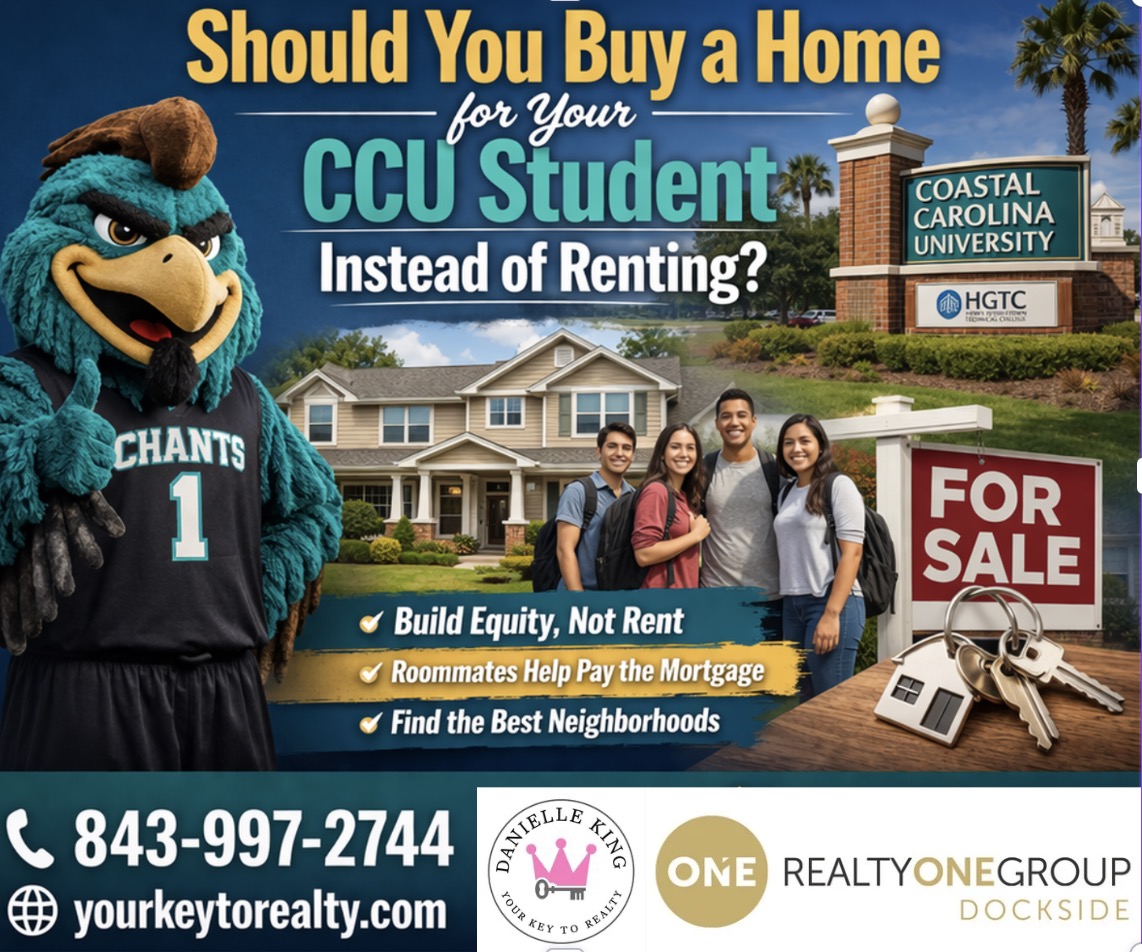
Should You Buy a Home for Your Coastal Carolina Student Instead of Paying Rent?
A Simple Guide for Students and Parents in Myrtle Beach
If you are heading to Coastal Carolina University or Horry Georgetown Technical College, you already know one thing is true.
Housing is not cheap.
Dorms fill up fast. Off campus rentals are expensive. And most students end up sharing space while still paying a high monthly cost.
So here is a better question to ask.
What if that money could go toward owning a home instead of renting one?
What Most Students and Parents Do
Most families follow the same path.
-
Pay for dorms the first year
-
Move into a rental after that
-
Pay monthly rent for four years
At the end of college, the money is gone.
There is no return. No ownership. No asset.
A Smarter Option to Consider
Some families are doing something different.
They are buying a condo, townhome, or house near campus.
Here is how it works.
-
The student lives in the home
-
Other students rent the extra rooms
-
The rent helps cover the monthly payment
This turns a normal expense into something that can build value.
Why This Works in the Coastal Carolina Area
The Myrtle Beach area has a strong student population.
-
Coastal Carolina University
-
Horry Georgetown Technical College
There are more students than available housing in many areas.
That means:
-
Rentals stay in demand
-
Students need places to live
-
Roommate style housing is very common
This creates an opportunity.
Why Rent When You Can Build Equity
When you rent:
-
You pay a landlord
-
The money is gone
When you own:
-
You build equity over time
-
You create a financial asset
-
You have options later
Even if the monthly payment is similar, the outcome is very different.
How Rental Income Can Help
This is one of the most important parts.
When buying a home like this, lenders may allow you to use part of the rental income to help qualify.
A common guideline is:
Up to 75 percent of the rental income can be used toward the loan qualification
Example:
-
Total rent from roommates is $2,000 per month
-
Lender may use $1,500 of that income
This can help make the numbers work.
Not every loan or situation is the same, but this is where strategy matters.
Can a Student Qualify for a Mortgage?
Most students cannot qualify on their own.
That is where parents come in.
Common options include:
-
Parent co signing
-
Parent being on the loan
-
Structuring the purchase with guidance from a lender
The goal is to create a plan that works for both the student and the parent.
What Type of Property Works Best?
There are a few good options.
Condos
-
Lower price point
-
Less maintenance
-
Check rental rules carefully
Townhomes
-
Very popular with students
-
Good mix of space and cost
Single Family Homes
-
More bedrooms
-
More rental potential
The best choice depends on:
-
Budget
-
Location
-
Rental rules
-
Layout of the home
What Happens After College?
This is where the long term benefit shows up.
After graduation, you can:
-
Keep the home as a rental
-
Sell it to another student or investor
-
Use the equity for your next purchase
Instead of walking away from rent, you walk away with options.
What to Watch Before Buying
Not every home will work for this plan.
You need to look at:
-
HOA rules and rental limits
-
Distance to campus
-
Condition of the property
-
Financing options
This is why it is important to have guidance before making a move.
The Big Question
You are going to pay for housing either way.
So ask yourself this.
Do you want that money to go toward rent, or toward something you own?
For Students Reading This
If you are in school or planning to attend Coastal Carolina or HGTC, send this to your parents.
This could change how your housing works for the next four years.
For Parents Reading This
If you are already planning to pay for housing, it may be worth looking at all your options first.
You may be able to:
-
Reduce out of pocket costs with rental income
-
Build equity during those four years
-
Create a property that can continue to produce income later
Let’s Talk About Your Options
If you want to know:
-
What areas near Coastal Carolina this works best in
-
Which properties allow rentals
-
How the 75 percent rental income guideline applies
-
What financing options are available
Reach out.
I will walk you through what works, what to avoid, and how to build a plan that fits your situation.
843-997-2744