Grand Strand Real Estate, Relocation, and Lifestyle Insights

This blog is designed to help buyers, sellers, and relocation clients better understand the Grand Strand and Coastal Carolina real estate market.

Whether you are researching communities, planning a move to South Carolina, or monitoring housing trends in the Myrtle Beach area, the goal is to provide clear and practical information that helps you make confident decisions.

You will find articles covering topics such as:

• Local housing market trends and home values
• Community and neighborhood guides throughout the Grand Strand
• Relocation advice for buyers moving from states like Pennsylvania, New Jersey, and New York
• Home buying and selling strategies in today’s market
• Lifestyle insights about living along the South Carolina coast

Many of the clients I work with are relocating from out of state and want to understand not only the housing market but also what daily life is like here. Articles often cover practical topics such as taxes, cost of living, community differences, and what to expect when moving to South Carolina.

If you are planning a move to Myrtle Beach, Carolina Forest, Conway, North Myrtle Beach, Little River, Georgetown, or nearby Coastal North Carolina communities, this blog is intended to serve as a helpful resource while you explore your options.

If you have questions about the local market or would like to schedule a private consultation or property tour, feel free to reach out anytime.

Danielle King, REALTOR®
North Carolina and South Carolina
Realty One Group Dockside

Phone: 843-997-2744
Email: danielle@yourkeytorealty.com
Website: yourkeytorealty.com

Equal Housing Opportunity

March 29, 2026

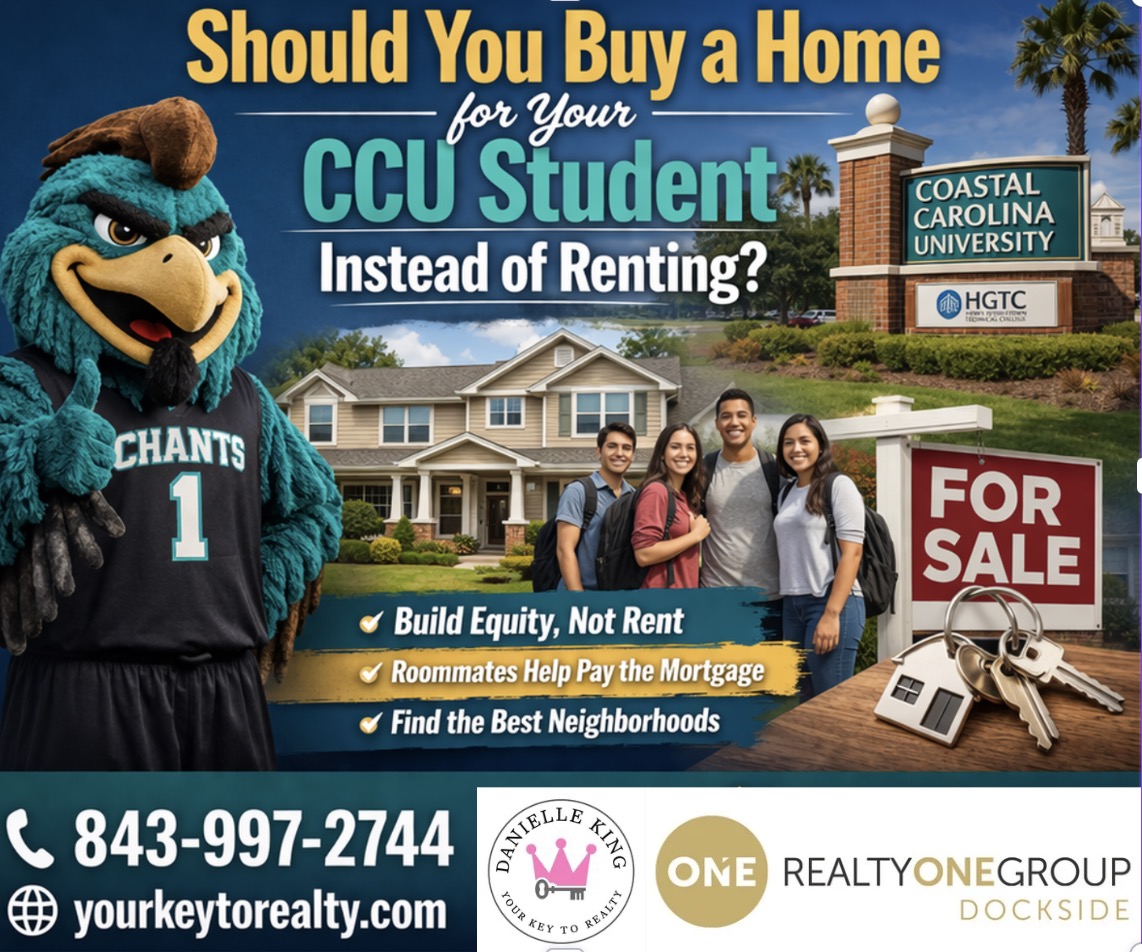
Should You Buy a Home for a Coastal Carolina Student Instead of Renting? Myrtle Beach College Housing Guide

CCU pay a drop or buy a home

Should You Buy a Home for Your Coastal Carolina Student Instead of Paying Rent?

A Simple Guide for Students and Parents in Myrtle Beach

If you are heading to Coastal Carolina University or Horry Georgetown Technical College, you already know one thing is true.

Housing is not cheap.

Dorms fill up fast. Off campus rentals are expensive. And most students end up sharing space while still paying a high monthly cost.

So here is a better question to ask.

What if that money could go toward owning a home instead of renting one?


What Most Students and Parents Do

Most families follow the same path.

  • Pay for dorms the first year

  • Move into a rental after that

  • Pay monthly rent for four years

At the end of college, the money is gone.

There is no return. No ownership. No asset.


A Smarter Option to Consider

Some families are doing something different.

They are buying a condo, townhome, or house near campus.

Here is how it works.

  • The student lives in the home

  • Other students rent the extra rooms

  • The rent helps cover the monthly payment

This turns a normal expense into something that can build value.


Why This Works in the Coastal Carolina Area

The Myrtle Beach area has a strong student population.

  • Coastal Carolina University

  • Horry Georgetown Technical College

There are more students than available housing in many areas.

That means:

  • Rentals stay in demand

  • Students need places to live

  • Roommate style housing is very common

This creates an opportunity.


Why Rent When You Can Build Equity

When you rent:

  • You pay a landlord

  • The money is gone

When you own:

  • You build equity over time

  • You create a financial asset

  • You have options later

Even if the monthly payment is similar, the outcome is very different.


How Rental Income Can Help

This is one of the most important parts.

When buying a home like this, lenders may allow you to use part of the rental income to help qualify.

A common guideline is:

Up to 75 percent of the rental income can be used toward the loan qualification

Example:

  • Total rent from roommates is $2,000 per month

  • Lender may use $1,500 of that income

This can help make the numbers work.

Not every loan or situation is the same, but this is where strategy matters.


Can a Student Qualify for a Mortgage?

Most students cannot qualify on their own.

That is where parents come in.

Common options include:

  • Parent co signing

  • Parent being on the loan

  • Structuring the purchase with guidance from a lender

The goal is to create a plan that works for both the student and the parent.


What Type of Property Works Best?

There are a few good options.

Condos

  • Lower price point

  • Less maintenance

  • Check rental rules carefully

Townhomes

  • Very popular with students

  • Good mix of space and cost

Single Family Homes

  • More bedrooms

  • More rental potential

The best choice depends on:

  • Budget

  • Location

  • Rental rules

  • Layout of the home


What Happens After College?

This is where the long term benefit shows up.

After graduation, you can:

  • Keep the home as a rental

  • Sell it to another student or investor

  • Use the equity for your next purchase

Instead of walking away from rent, you walk away with options.


What to Watch Before Buying

Not every home will work for this plan.

You need to look at:

  • HOA rules and rental limits

  • Distance to campus

  • Condition of the property

  • Financing options

This is why it is important to have guidance before making a move.


The Big Question

You are going to pay for housing either way.

So ask yourself this.

Do you want that money to go toward rent, or toward something you own?


For Students Reading This

If you are in school or planning to attend Coastal Carolina or HGTC, send this to your parents.

This could change how your housing works for the next four years.


For Parents Reading This

If you are already planning to pay for housing, it may be worth looking at all your options first.

You may be able to:

  • Reduce out of pocket costs with rental income

  • Build equity during those four years

  • Create a property that can continue to produce income later


Let’s Talk About Your Options

If you want to know:

  • What areas near Coastal Carolina this works best in

  • Which properties allow rentals

  • How the 75 percent rental income guideline applies

  • What financing options are available

Reach out.

I will walk you through what works, what to avoid, and how to build a plan that fits your situation.

843-997-2744

March 12, 2026

How to Sell Your House Fast in Myrtle Beach

How to Sell Your House Fast

Smart Strategies That Help Homes Sell Quickly

Many homeowners search online for advice about how to sell their house fast. Whether you are relocating, downsizing, or simply ready for a change, most sellers want a smooth transaction and a strong offer without their property sitting on the market for months.

Homes across the Myrtle Beach area, including communities like Carolina Forest, Market Common, Conway, Murrells Inlet, and the surrounding coastal areas, continue to attract buyers relocating from across the country. Even with strong demand, however, some homes sell quickly while others remain on the market longer than expected.

Understanding what influences buyer behavior can help sellers position their home to attract serious interest right away.


Price Your Home Correctly From the Start

One of the most important factors when trying to sell your house quickly is pricing strategy.

Many sellers assume pricing higher leaves room for negotiation. In reality, homes priced too high often sit on the market longer, which can cause buyers to question the property.

Buyers typically monitor new listings closely during the first week a property becomes available. Pricing your home competitively from the beginning can help create stronger early interest and potentially generate multiple offers.

A local market analysis comparing similar homes that have recently sold can help determine an appropriate price range.


First Impressions Matter Online

Today’s buyers usually discover homes online before ever scheduling a showing. Because of this, presentation plays a major role in how quickly a property attracts attention.

Professional marketing often includes:

• high quality listing photography
• drone footage showing the home and surrounding neighborhood
• floor plans that help buyers understand layout
• video walkthroughs or virtual tours
• a dedicated property website or listing page

These tools help buyers visualize the home before visiting in person and often lead to stronger initial interest.


Decluttering and Preparation Can Make a Big Difference

Preparing your home for showings is another important step when trying to sell your house fast.

Buyers tend to focus more on the home itself when spaces feel clean, open, and well organized. Simple improvements can help the property show better without requiring major renovation projects.

Common preparation steps include:

• removing excess furniture or clutter
• improving lighting throughout the home
• addressing minor maintenance items
• enhancing curb appeal at the entrance

Small changes can often make a meaningful difference in how buyers perceive the property.


Not Every Renovation Provides a Return

Before investing in large upgrades, many homeowners benefit from speaking with a real estate professional first.

It is common for sellers to assume renovations will significantly increase the value of their home. In reality, some projects may not provide the return sellers expect.

For example, homeowners sometimes spend $20,000 on improvements only to discover the market may value those changes closer to $3,000 to $5,000 when the home sells.

Understanding what buyers are currently prioritizing can help determine which improvements may be worthwhile and which may not.


Strategic Marketing Creates More Buyer Exposure

Selling a home quickly often comes down to visibility.

The more qualified buyers who see the property, the greater the chances of receiving strong offers. Marketing strategies may include:

• MLS exposure to licensed agents
• social media promotion
• targeted digital marketing
• open houses when appropriate
• direct outreach to buyer agents

Simply placing a home on the market is not always enough. Strategic marketing helps ensure the property reaches the right audience.


Negotiation Matters Once Offers Arrive

Selling quickly does not mean accepting the first offer without review.

Strong negotiation can help sellers evaluate important terms such as:

• purchase price
• financing contingencies
• inspection requests
• closing timeline
• appraisal considerations

Even when a property receives multiple offers, structuring the agreement properly helps ensure the transaction moves smoothly toward closing.


Interviewing the Right Agent Can Make a Difference

Before listing a home, many homeowners find it helpful to interview two or three agents. Each professional may offer different perspectives on pricing, marketing, and negotiation strategies.

When speaking with agents, homeowners often ask questions such as:

• How did you determine the listing price?
• What marketing strategy will you use for my home?
• Will you provide professional photography, drone footage, or floor plans?
• Will you host open houses or actively promote the property?
• How will you keep me informed about buyer feedback?

These conversations can help sellers feel more confident about the plan used to market their property.


Selling Your House Fast Starts With the Right Strategy

Homes that sell quickly often share a few common characteristics:

• competitive pricing
• strong presentation
• professional marketing
• clear communication during negotiations

When these elements come together, properties tend to attract attention early in the listing period.


Thinking About Selling Your House?

If you are considering selling your house in the Myrtle Beach area, reviewing recent comparable sales and buyer activity can help you understand what may be possible in today’s market.

Every property and situation is different, and sometimes a short conversation can help homeowners better understand their options before deciding what to do next. View our home valuation tool here


Danielle King, REALTOR®
SC License #145618 | NC License #363826
Realty ONE Group Dockside North

Phone: 843-997-2744

March 12, 2026

Selling Your House in Myrtle Beach | What Homeowners Should Know


Selling Your House in the Myrtle Beach Area

What Homeowners Should Know Before Listing Their Property

If you are thinking about selling your house in the Myrtle Beach area, you probably have several questions. Many homeowners want to know how much their home might sell for, how quickly it could sell, and what steps they should take before putting their property on the market.

Across the Grand Strand, communities like Carolina Forest, Market Common, Conway, Murrells Inlet, and surrounding coastal areas continue to attract buyers relocating to the region. As buyer demand, interest rates, and inventory levels change, the way a home is priced and marketed plays a major role in how successful the sale will be.

Before deciding on repairs, renovations, or listing strategy, it helps to understand what actually drives home value in today’s market.


What Determines How Much Your House Will Sell For

One of the most common questions homeowners ask is “how much will I make selling my house?”

The final sale price of a property depends on several key factors, including:

• recent comparable sales in your neighborhood
• current homes competing for buyers
• overall buyer demand in the local market
• the condition and presentation of the property
• pricing strategy when the home first enters the market

Online home value calculators can offer a rough estimate, but they often miss important details such as upgrades, lot location, or the condition of major systems like roofing or HVAC.

A local market review that examines recent sales and active listings usually provides a clearer picture of where your home may fit in the current market.


Talk With an Agent Before Starting Major Renovations

Many homeowners assume they should complete large renovation projects before selling their house. While certain improvements can increase buyer appeal, others may not provide the return sellers expect.

Before investing money into upgrades, it is often helpful to speak with a real estate professional who understands what buyers in your local market are currently prioritizing.

Without that guidance, homeowners sometimes spend money on projects that do not significantly increase the home’s value.

It is not uncommon for a homeowner to invest $20,000 in improvements only to discover the market may value those changes at $3,000 to $5,000 when the property sells.

In many situations, simple preparation steps can make a larger impact, including:

• decluttering living spaces
• improving lighting and cleanliness
• addressing minor repairs
• enhancing curb appeal

These steps help buyers focus on the home itself rather than distractions.


Preparing Your House for the Market

Many buyers begin their home search online before scheduling showings. Because of this, presentation plays a major role in attracting interest.

Effective marketing strategies may include:

• professional photography
• drone footage showing the property and surrounding area
• floor plans to help buyers understand layout
• video walkthroughs or virtual tours
• a dedicated property website or URL for the listing

These tools help buyers visualize the home before they ever step inside.

The more qualified buyers who see the property, the stronger the seller’s negotiating position can become.


Should You Sell Your House As-Is?

Another common question homeowners research online is whether they should sell their house as-is.

Selling as-is means the homeowner may not complete repairs before listing the property. In certain situations this can make sense, particularly if the home requires extensive updates or the seller prefers a faster transaction.

However, many homes do not require major repairs to attract buyers. Often basic preparation and strong marketing are enough to generate interest.

Reviewing comparable sales and buyer expectations in your price range can help determine whether selling as-is is the best strategy.


Selling Your House Yourself vs Working With an Agent

Some homeowners also consider selling their house themselves rather than working with an agent.

While selling independently may seem appealing, many sellers discover the process involves more complexity than expected once negotiations, contracts, inspections, and financing timelines are involved.

Working with an experienced real estate professional can help with:

• pricing strategy
• marketing exposure
• negotiating offers
• managing inspections and deadlines
• navigating closing requirements

For many homeowners, the goal is not simply selling the home, but achieving the strongest possible outcome.


Why It’s Smart to Interview Multiple Agents

Another important step when selling your house is choosing the right agent.

Many homeowners find it helpful to speak with two or three agents before deciding who will represent their property. Each agent may bring a slightly different perspective on pricing, marketing strategy, and negotiation approach.

When interviewing agents, homeowners may want to ask:

• How did you determine the suggested listing price?
• What marketing strategy will you use to promote my home?
• Will you include professional photography, drone footage, and floor plans?
• Will you host open houses or actively promote the property?
• How often will you provide feedback from buyers and agents?

These conversations can help homeowners feel more confident about the strategy used to sell their home.


Selling Your House Fast Starts With Strategy

Many homeowners searching online want to know how to sell their house fast. While every market is different, homes that sell quickly often share several characteristics:

• strategic pricing
• strong marketing exposure
• professional presentation
• active communication with buyers and agents

The goal is not simply listing a home in the MLS, but positioning it so it stands out to buyers who are comparing multiple properties.


Thinking About Selling Your House?

If you are considering selling your house in the Myrtle Beach area, starting with clear information about the current market can help you decide the best strategy moving forward.

A review of recent comparable sales and buyer activity can often provide valuable insight into what your home may be worth today. Check out our home valuation tool here

Sometimes a short conversation can help homeowners better understand their options before deciding what to do next.


Danielle King, REALTOR®
SC License #145618 | NC License #363826
Realty ONE Group Dockside North

Phone: 843-997-2744


March 12, 2026

New Construction vs Resale Homes | Carolina Forest, Market Common, Conway SC


New Construction vs Resale Homes in Carolina Forest, Market Common, and Conway

Why Today’s Builder Incentives Are Changing the Math for Buyers

If you are deciding between a new construction home and a resale property in the Myrtle Beach area, the conversation has shifted significantly over the past few years. Builder incentives and financing programs are making brand new homes more competitive than many buyers expect. In some situations, a newly built home can even result in a lower monthly payment than an older resale property.

For buyers relocating to the Grand Strand, Carolina Forest, Market Common, and Conway are three of the most sought-after areas to consider. Each community offers its own lifestyle, amenities, and housing options while still being conveniently located near the beach.

Understanding how builder incentives work today can make a major difference in determining what is actually affordable.


The Traditional Trade-Off Between New Construction and Resale

For many years, resale homes were often considered the better value. Established neighborhoods typically offered mature landscaping, larger trees, and homes that were already part of a settled community.

New construction homes, on the other hand, provided modern floor plans, open kitchens, energy efficient systems, and new warranties, but usually came at a higher price.

In communities like Carolina Forest and Conway, where new development continues to expand, that gap has narrowed considerably. In some cases, the monthly cost of a brand new home can now compete with or even beat older resale homes once builder incentives are factored into the equation.


Why New Construction Is Getting Serious Attention

Many builders across the Myrtle Beach area are currently offering incentives designed to help buyers manage affordability in today’s market. These incentives may include loan programs tied to:

  • FHA loans

  • VA loans

  • USDA loans

Some builders have promoted rates beginning around 3.99 percent for qualifying buyers on select programs. Availability, qualifications, and program details vary, but the impact on monthly payments can be significant.

In addition to interest rate incentives, certain new construction homes may also include:

  • Appliance packages

  • Builder paid closing costs

  • Structural warranties

  • Customizations

For buyers relocating to the Coastal Carolina region, these incentives can make the path to homeownership much more manageable.


Monthly Payment Reality Check

This is where many buyers pause and look closely at the numbers.

A new construction home priced around $260,000 to $320,000 can sometimes result in a monthly payment near or below $1,600 depending on loan type, taxes, insurance, and available builder incentives.

That number is important because many renters throughout the Myrtle Beach area are paying similar monthly costs for apartments.

The difference is simple: rent builds no equity, while homeownership builds equity with every payment.


How Resale Homes Compare Right Now

Resale homes in Carolina Forest, Market Common, and Conway can still be excellent options, particularly for buyers who prefer established communities or unique home styles.

Market Common, for example, offers walkable neighborhoods, townhomes, and homes close to restaurants, parks, and boutique shopping.

Conway provides a different type of charm with its historic downtown, riverwalk, and small-town atmosphere, while still being only a short drive from the beach.

However, resale homes can also come with factors buyers should consider:

  • Higher mortgage rates without builder rate buydowns

  • Older roofs, HVAC systems, or appliances

  • Fewer seller concessions in competitive price points

  • Pricing pressure from nearby new construction communities

In some cases, resale homes may actually cost more on a monthly basis than comparable new construction homes once incentives are considered.


The Lifestyle Advantage of These Communities

Housing decisions are about more than numbers. Lifestyle plays a major role in why buyers choose these areas.

Carolina Forest residents enjoy convenient grocery options like Publix, Lowes Foods, Kroger, and Food Lion, along with nearby dining options such as Sol y Luna, River Oaks, Fire & Smoke, and Drift.

Market Common offers a vibrant walkable community with restaurants like Crepe Creation Café, Travinia Italian Kitchen, Tupelo Honey, and The Brass Tap, along with parks such as Grand Park and Savannah’s Playground.

Conway offers a charming historic setting with local favorites like Rivertown Bistro, Crooked Oak Tavern, Bonfire Taqueria, and Trestle Bakery, along with scenic attractions such as the Conway Riverwalk along the Waccamaw River.

All three areas provide easy access to the Myrtle Beach Boardwalk, Myrtle Beach State Park, golf courses, and the Atlantic coastline.


Which Option Is Right for You

There is no single answer when comparing new construction and resale homes. The right choice depends on factors such as:

  • Financing options

  • Monthly payment goals

  • Location preferences

  • How long you plan to stay in the home

  • Comfort with maintenance or renovation projects

The key is understanding all available options using real numbers and current market conditions.


Let’s Explore What Is Possible

If you are currently renting, relocating to Myrtle Beach, or planning to buy later this year, it may be worth exploring how builder incentives could affect your monthly payment and closing costs.

I woulvd be happy to walk you through new construction communities and resale homes in Carolina Forest, Market Common, and Conway, helping you compare real scenarios so you can make the best decision for your situation.

If you would like to see what is currently available or learn how builder incentives may help reduce your overall costs, feel free to reach out anytime.


Danielle King, REALTOR®
SC License #145618 | NC License #363826
Realty ONE Group Dockside North

843-997-2744


March 10, 2026

Moving to South Carolina With Firearms: Laws, Transport Rules, and What New Residents Should Know

Moving to South Carolina With Firearms: Laws, Transport Rules, and What New Residents Should Know

Last updated: March 10, 2026

Moving to South Carolina is a big change. Jobs, housing, and daily life all shift. Firearm laws change too.

Many people relocating to South Carolina from states like Pennsylvania, New Jersey, and New York ask how firearm laws differ once they move. South Carolina operates under a different legal framework than many northeastern states, so understanding the basics before your move can make the transition much smoother.

If you lawfully own firearms, understanding South Carolina rules is part of smart relocation planning.

This guide answers common questions and explains what to expect before, during, and after your move.

This information is general only and is not legal advice.


South Carolina Firearm Laws at a Glance

South Carolina does not require firearm registration or purchase permits. Once you establish residency, South Carolina law applies instead of the laws from your prior state.

Here are the basics most new residents notice quickly.

Common Differences for New Residents

No firearm registration

South Carolina does not require new residents to register firearms after moving.

No purchase permits

There is no permit required to purchase handguns or long guns from licensed dealers.

Lawful carry with an optional permit

South Carolina allows lawful carry for eligible adults. A Concealed Weapon Permit, often called a CWP, is optional.

Location rules still apply

Certain locations restrict firearms regardless of permit status. These include schools, courthouses, and many government buildings.


Can You Bring Firearms When Moving to South Carolina?

Yes. Federal law generally allows interstate transportation of firearms when they are unloaded and properly secured during travel.

Most people relocating to South Carolina transport their firearms themselves when moving from states like Pennsylvania, New Jersey, or New York. When traveling across state lines, firearms are typically transported unloaded and stored in a locked case, with ammunition stored separately.

During interstate travel, federal law commonly referred to as the Firearm Owners Protection Act (FOPA) allows transportation between places where the firearm is legally possessed, provided certain conditions are met.

Because individual state laws may differ during overnight stops or extended travel, many firearm owners plan their route in advance and review the laws of states they will pass through.

Once you establish residency in South Carolina, South Carolina law applies to firearm possession and carry.


What Happens to Your Out-of-State Carry Permit?

This question comes up often.

Before you establish residency, South Carolina may recognize an out-of-state carry permit if reciprocity exists with your home state.

After you become a South Carolina resident, usually marked by obtaining a South Carolina driver's license, your prior permit typically no longer applies. From that point forward, South Carolina law governs possession and carry.


Planning Your Move With Firearms

Good planning reduces stress. Firearm moves are no different.

Start early.

30 to 60 Days Before Moving

Review what you own and confirm all firearms are lawfully possessed under federal and current state law. Items regulated under the National Firearms Act require additional planning for interstate transport.

Plan your travel route. Federal law allows interstate transport when firearms are unloaded and secured, but state laws may apply during stops or overnight stays.


Choosing How to Transport Firearms

Many owners choose to transport firearms themselves during a move. This allows clearer control and simpler compliance.

If you use a moving company, ask about firearm policies in advance. Some movers require separate handling or documentation.


Best Practices During Transit

When traveling across state lines, common best practices include:

• Keep firearms unloaded
• Store firearms in locked cases
• Keep ammunition stored separately
• Place cases out of reach in the vehicle
• Carry required paperwork for regulated items

These steps help align with federal rules and varying state laws during transit.


Establishing South Carolina Residency

Residency usually begins when you take formal steps such as:

• Obtaining a South Carolina driver's license
• Registering vehicles in South Carolina
• Establishing a permanent address

Once residency is established, South Carolina law controls firearm possession and carry.

Many people relocating to the Myrtle Beach and Grand Strand area complete these steps shortly after purchasing a home or establishing a permanent residence.


Deciding Whether to Apply for a South Carolina CWP

A South Carolina Concealed Weapon Permit is optional. Some new residents apply because it offers:

• Documented training
• Reciprocity when traveling to other states
• Familiarity with South Carolina specific rules

Applications are handled by the South Carolina Law Enforcement Division and require approved training and a background check.


Frequently Asked Questions

Do I need to notify anyone when I move with firearms?

South Carolina does not require firearm registration or notification when you move with lawfully owned firearms.

Can I keep a firearm in my vehicle?

South Carolina law allows lawful possession in vehicles under certain conditions. Secure storage is recommended.

What if I am moving from a restrictive state?

Some items that were restricted in another state may be lawful in South Carolina. Federal law still applies.

Are there restricted locations?

Yes. Firearms are restricted in certain places such as schools, courthouses, government buildings, and posted private property.

Do new residents need a concealed weapon permit?

No. A permit is optional, though some residents obtain one for reciprocity with other states.


Helpful Resources

Official sources

South Carolina Law Enforcement Division
Bureau of Alcohol, Tobacco, Firearms and Explosives
South Carolina General Assembly statutes

Additional guidance

Licensed firearms attorneys in South Carolina
Approved firearms training instructors
Local law enforcement for location-specific questions


Final Thoughts

Relocating with firearms does not need to be complicated.

Preparation makes the process smoother, and verified information matters.

Understanding South Carolina law before you move, transporting firearms responsibly, and knowing what changes after residency helps avoid confusion.

This article is for general information only. Laws change and individual situations vary. Always confirm current requirements through official sources or qualified legal counsel.


If you are planning a move to Myrtle Beach, Conway, North Myrtle Beach, or anywhere along the Grand Strand, I offer free consultations and private property tours tailored to your needs and timeline.


Danielle King, REALTOR®
North Carolina and South Carolina
Realty One Group Dockside

Phone: 843-997-2744
Email: danielle@yourkeytorealty.com
Website: yourkeytorealty.com


Homes for sale in Myrtle Beach under $500k


Homes with a pool


Homes with Boat Dock Access


55+ Communities

Oct. 2, 2025

Welcome to Your Local Real Estate Resource

Welcome to Your Local Real Estate Resource

This website is built specifically for your local market—not a national portal. Whether you're buying, selling, or just exploring, you'll find tools and insights tailored to your community, backed by real people who are here to help.

🔍 Search for Homes in Your Area

Use our Home Search tool to explore listings that match your needs. Filter by location, price, and features to find homes that fit your lifestyle.

👉 Start Your Home Search

📊 Stay Informed with Market Reports

Our Market Reports give you up-to-date insights on pricing trends, inventory, and recent sales in your neighborhood. It’s a great way to stay ahead—whether you're buying or selling.

👉 View Market Reports

💰 Know Your Home’s Value

Thinking about selling? Use our Home Value tool to get a quick estimate of your property’s worth in today’s market. It’s fast, free, and a great starting point.

👉 Check Your Home Value

👋 Talk to a Real Local Expert

This isn’t just a website—it’s backed by real humans who know your area and are ready to help. Visit our About Us page to learn more about your local agent and how they can support your real estate journey.

👉 Contact Us


Thanks for visiting!
We’ll be updating this blog regularly with tips, insights, and local updates. And if you ever have questions, just reach out—we’re here to help.

Posted in Market Updates